
RapidWeld is a collaborative project involving SSE Renewables, Cambridge Vacuum Engineering (CVE), DNV, Sif Netherlands B.V, Agile NDT and The Welding Institute (TWI). The companies joined forces to explore the benefits of electron beam (EB) welding in the creation of wind turbine monopiles.
Using funding from Innovate UK, the RapidWeld team wanted to demonstrate that electron beam (EB) welding is significantly quicker, cheaper, cleaner and more energy efficient than existing techniques, while also producing higher quality welds with excellent fatigue properties.
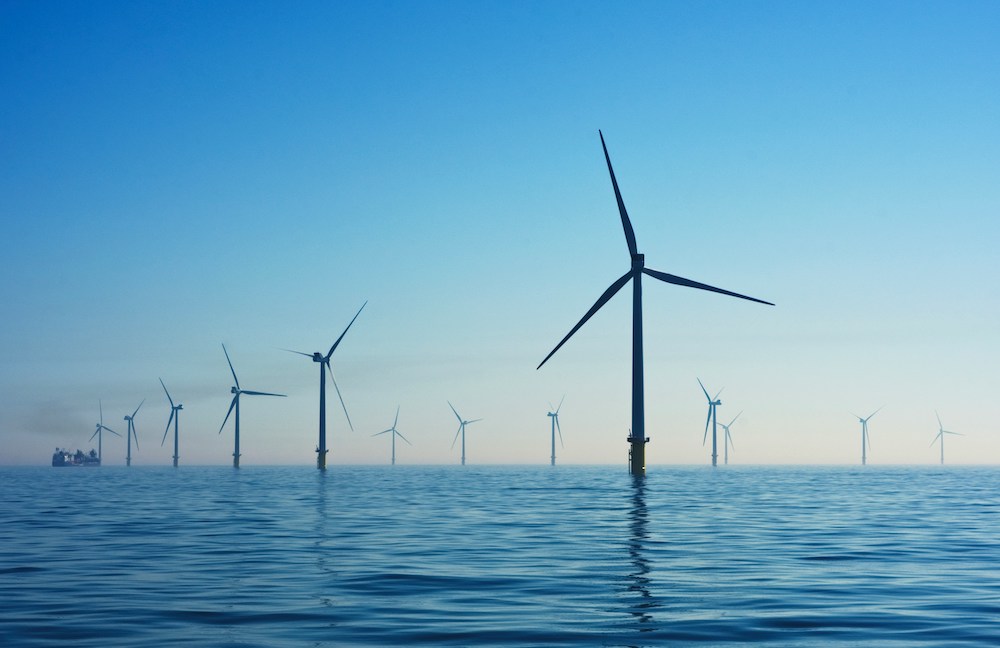
The development of wind turbines for offshore locations like the North Sea presents many technical and logistical challenges. Creating turbines and foundation pieces that can withstand extreme marine conditions requires welds of the highest quality and consistency.
This can involve lengthy production timescales that are out of kilter with the sustainability goals of energy companies and the race to net zero. Currently, wind turbine monopiles, a critical component of wind turbine foundations, are typically fabricated using traditional welding methods such as submerged arc welding (SAW); however, these methods are limited in terms of speed, cost and the quality of welds produced.
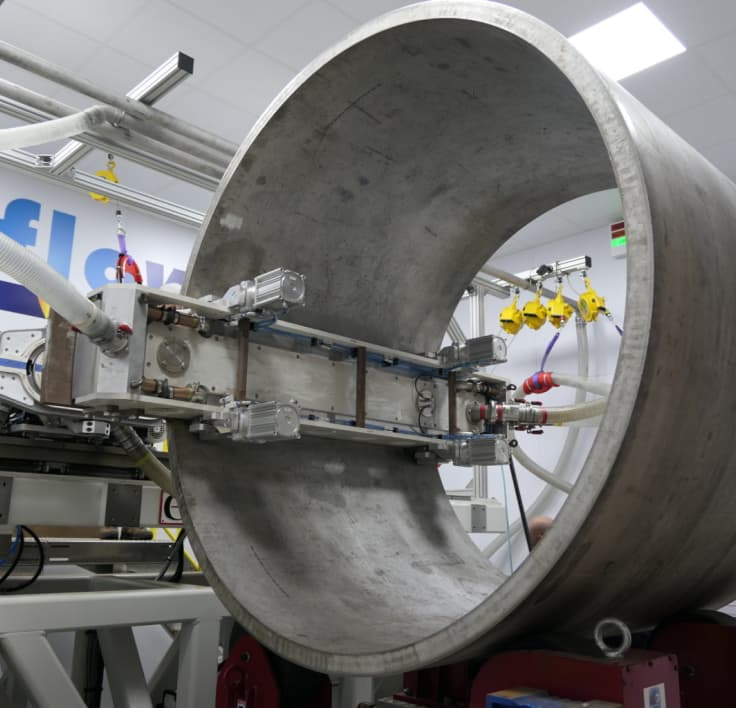
Working together using Ebflow, the RapidWeld team set about creating a monopile foundation for the Dogger Bank Wind Farm project. An Ebflow machine was installed at Sif’s Maasvlakte 2 facility in Rotterdam.
The machine performed several longitudinal welds on 2750mm length seams on 8m diameter rolled cans with a wall thickness of between 69mm and 85mm.
The plan was for resulting samples to be assessed in accordance with DNV-OS-C401, the standard for Fabrication and Testing of Offshore Structures. Concurrently, Dogger Bank also planned to commission fatigue testing to ensure the welds could deliver over 20 years of offshore service.
Using Ebflow, the RapidWeld team welded the first-ever electron beam welded foundation piece for the Dogger Bank turbine monopile, with dramatic results. The piece was welded at least 25 times faster than the current default manufacturing method; production required 90% less energy and cost 88% less, and the approach also produced 97% less CO2 emissions.
Crucially, the quality of the weld met the mechanical and metallurgical properties needed to satisfy construction codes and design requirements. The resulting monopile has subsequently been shipped to and installed at the Dogger Bank Wind Farm, where it is helping to generate clean, green energy.
The validation of Ebflow for offshore projects has huge implications for the energy sector’s net zero ambitions; the significant time and cost savings achievable with Ebflow have the potential to help accelerate the delivery of more wind farms worldwide.
Ebflow also requires less energy and does not require consumable materials like fillers, reducing the carbon footprint associated with manufacturing core green energy infrastructure. Because Ebflow is easily transportable, it can unlock further carbon savings by increasing opportunities for local manufacture of infrastructure components close to customers or project locations; for wind turbines this could prove particularly beneficial in Europe, where many monopiles, jackets and towers are currently sourced from the Far East.